Nissan Service Schedule: Factory Mileage Tips
Core Nissan Service Schedule: Routine Maintenance Intervals
Disclaimer: This content is for informational purposes only. Vehicle maintenance, diagnostics, and repairs should only be completed by a certified Nissan technician. Always consult our service department and your vehicle owner’s manual before conducting any repairs or maintenance.
Staying consistent with your Nissan service schedule protects engine longevity, safeguards mechanical reliability, and preserves everyday performance. Nissan establishes standard intervals based on mileage and elapsed time. For internal combustion engines, routine care centers on engine oil, filter replacements, fluid inspections, and comprehensive multi-point inspections.
At routine intervals, certified technicians evaluate key wear items such as brake pads, tire tread depth, suspension components, and the 12-volt battery. Because engine sizes, drivetrains, and driving habits differ, always follow the maintenance guide tailored to your vehicle's specific model year and configuration.
Every 5,000 to 7,500 Miles: Essential Checks
For most conventional gas-powered Nissan models, standard maintenance occurs every 5,000 miles or 6 months, whichever comes first. During this service visit, technicians perform:
- Engine oil and genuine Nissan oil filter replacement using factory-specified viscosity
- Tire inspection and a tire rotation service (recommended by Nissan every 7,500 miles or 6 months to ensure even tread wear)
- Visual brake pad and rotor inspections (with comprehensive pad thickness checks at least every 10,000 miles or 12 months)
- Fluid level checks and top-offs for windshield washer fluid, coolant, and brake fluid
- Checking battery health and terminal connections
Certain newer engines or driving routines permit intervals up to 7,500 miles, but you should always check the owner's manual rather than treating 7,500 miles as a universal benchmark.
Adapting the Nissan Service Schedule for Severe Driving Conditions
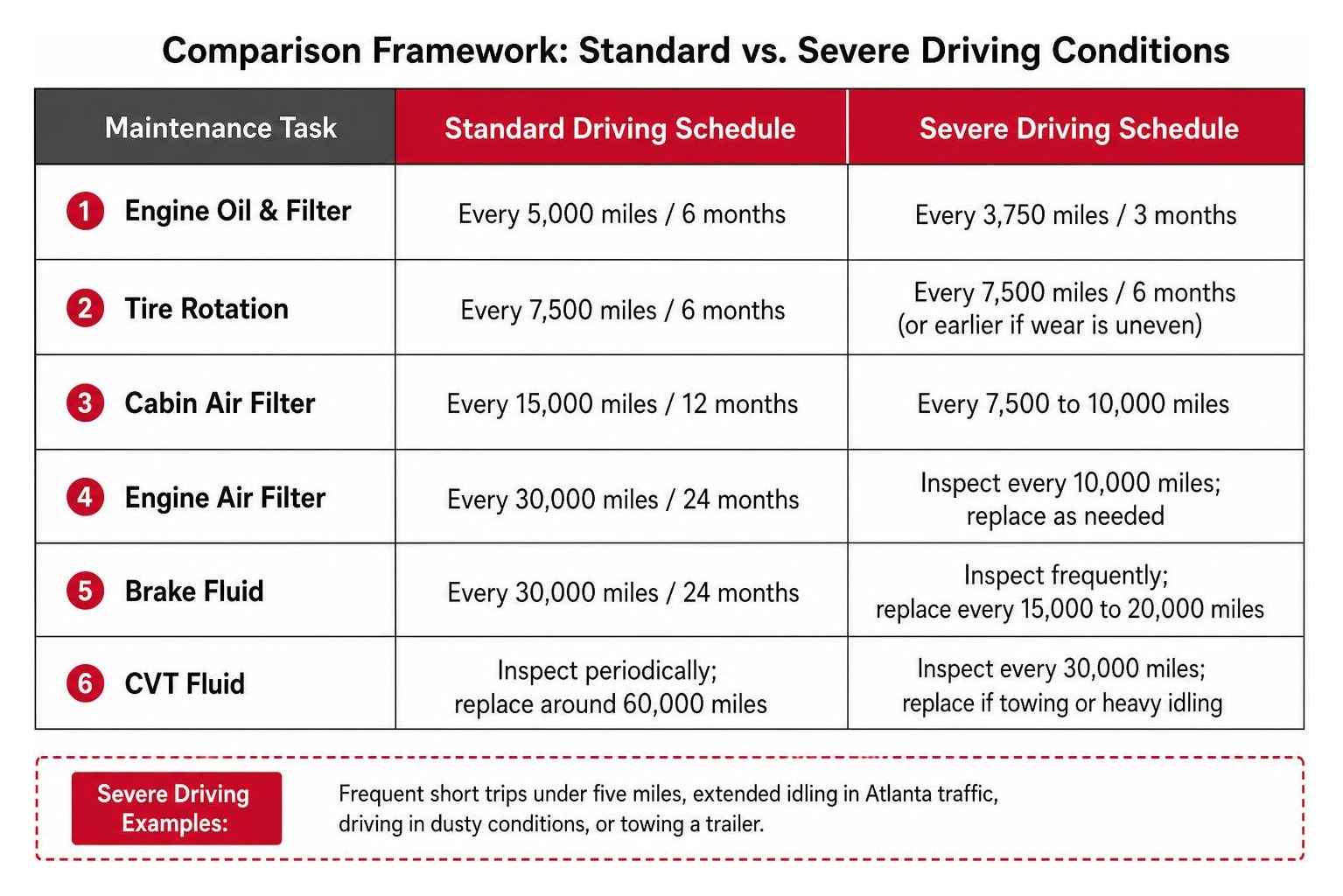
Operating conditions directly impact fluid degradation and component wear. If your daily commute involves frequent short trips under five miles, extended idling in Atlanta traffic, driving in dusty conditions, or towing a trailer, Nissan recommends following the severe driving schedule.
Under severe operating conditions, engine oil and filter replacements are often recommended every 3,750 miles or 3 months.
| Maintenance Task | Standard Driving Schedule | Severe Driving Schedule |
|---|---|---|
| Engine Oil & Filter | Every 5,000 miles / 6 months | Every 3,750 miles / 3 months |
| Tire Rotation | Every 7,500 miles / 6 months | Every 7,500 miles / 6 months (or earlier if wear is uneven) |
| Cabin Air Filter | Every 15,000 miles / 12 months | Every 7,500 to 10,000 miles |
| Engine Air Filter | Every 30,000 miles / 24 months | Inspect every 10,000 miles; replace as needed |
| Brake Fluid | Every 30,000 miles / 24 months | Inspect frequently; replace every 15,000 to 20,000 miles |
| CVT Fluid | Inspect periodically; replace around 60,000 miles | Inspect every 30,000 miles; replace if towing or heavy idling |
Major Mileage Milestones and Manufacturer Maintenance Guidance
Beyond routine oil changes and rotations, major mileage intervals address deeper mechanical wear. Preventative service at these points ensures components do not fail prematurely, helping you avoid costly roadside breakdowns.
30,000-Mile and 60,000-Mile Maintenance Checks
The 30,000-mile mark represents a major service milestone. At this interval, factory guidance typically calls for:
- Replacement of the in-cabin microfilter (cabin air filter), normally serviced every 15,000 miles or 12 months
- Replacement of the engine air cleaner filter (recommended every 30,000 miles or 24 months)
- Full brake fluid replacement (recommended every 30,000 miles or 24 months)
- Inspection of the exhaust system, steering gear, linkage, axle, and suspension parts
When your vehicle reaches 60,000 miles or 5 years, services expand to include:
- Engine coolant flush and replacement
- Spark plug replacement on select engines (verify specific engine requirements, as standard platinum or iridium spark plug replacement intervals often fall around 60,000 to 105,000 miles depending on model year)
- Transmission fluid replacement for models equipped with an Xtronic Continuously Variable Transmission (CVT)
- Comprehensive multi-point inspection of drive belts and cooling hoses
90,000-Mile and 120,000-Mile Long-Term Care
High-mileage reliability requires attention to wear items that endure hundreds of hours of heat cycling:
- Drive Belt Service: Drive belts are inspected for cracking, fraying, or tension loss, with replacement recommended around 100,000 miles.
- Cooling System: Radiator hoses, heater hoses, and clamps are inspected for softening or brittleness.
- Suspension and Steering: Struts, shocks, ball joints, and tie rod ends undergo physical inspection for fluid leaks or play.
- Fuel System: Fuel lines and vapor lines are checked for integrity. Fuel induction cleaning or injector services are performed only when indicated by diagnostic testing or noticeable driveability symptoms.
Model-Specific Maintenance: Sedans, SUVs, Trucks, and EVs
Every vehicle category in the Nissan lineup features engineering characteristics that influence its service routine.
Customizing the Nissan Service Schedule for Your Model
- Sedans (Altima, Sentra): Front-wheel-drive sedans rely heavily on proper CVT fluid condition and regular front tire rotations to balance out steering and braking loads.
- Crossovers and SUVs (Rogue, Pathfinder, Murano, Armada, Kicks): All-Wheel Drive (AWD) and Four-Wheel Drive (4WD) models require periodic inspection of the transfer case fluid and rear differential gear oil, especially if driven on unpaved roads or used for family road trips with heavy cargo.
- Trucks (Frontier): Rear-wheel-drive and 4x4 trucks carrying payloads or hauling trailers require strict adherence to severe-schedule rear axle lubricant inspections and propeller shaft lubrication.
- Electric Vehicles (Leaf): All-electric powertrains eliminate oil changes, spark plugs, and exhaust checks. EV maintenance focuses primarily on cabin air filters, tire rotations, brake fluid moisture testing, chassis lubrication, and EV battery cooling system inspections.
To ensure proper fit and long-term durability, our team installs genuine OEM components engineered specifically for your chassis.
Service Costs, DIY Maintenance, and Warranty Protection

Maintenance costs depend on your model, the mileage milestone reached, and whether any secondary wear parts require replacement. Dealership service centers use factory-trained technicians, specialized diagnostic equipment, and original equipment parts, ensuring factory standards are strictly maintained.
While basic inspections might seem approachable, comparing DIY and professional service shows that professional service provides documented proof in official manufacturer databases, keeping your vehicle records organized. To assist with seasonal maintenance costs, drivers can review current service specials before booking a visit.
How to Reset the Nissan Service Reminder Light
After completing maintenance, the onboard maintenance reminder light can be reset through the vehicle settings:
- Turn the vehicle ignition to the ON position without starting the engine (or press the start button twice with your foot off the brake).
- Using the steering wheel directional controls, scroll through the multi-information display menu until you reach Settings.
- Scroll down and select Maintenance.
- Choose the specific category to reset (such as Oil and Filter, Tire, or Other).
- Select Reset, confirm by choosing Yes, and verify the mileage counter clears.
Resetting a dashboard reminder is solely an informational record keeping step. It does not replace the physical maintenance work required to protect the vehicle.
Protecting Factory Warranty Coverage and Ownership Value
Following the scheduled maintenance roadmap is essential for maintaining your warranty protections:
- Factory Warranty Compliance: Checking factory warranty terms highlights that coverage requires adherence to the maintenance schedule. If a mechanical breakdown occurs due to neglected fluids or missing services, warranty claims may be denied.
- Asset Protection: Reviewing a comprehensive vehicle warranty guide to protecting your investment confirms that documented maintenance histories directly support resale and trade values.
- Certified Pre-Owned Standards: Understanding how certified pre-owned coverage works emphasizes that pre-owned warranty programs require consistent maintenance documentation throughout the ownership lifecycle.
Preparing for a Nissan Maintenance Visit
A productive service visit starts with accurate information. Before the appointment, note the current mileage, the last time the oil was changed, and any dashboard messages that appear. If there is a concern, write down when it happens and what the vehicle is doing at the time. For example, mention whether a vibration occurs during braking, a noise is more noticeable on a cold start, or a warning light appeared after a particular trip. Clear details help the service team understand what to inspect without treating a general symptom as a confirmed diagnosis.
It is also useful to bring recent maintenance records if service was completed elsewhere. Those records can help the technician see which fluids, filters, tires, or inspections may already have been addressed. If you are unsure what was completed, the Service Department can review the VIN, available history, and the manufacturer maintenance guide to identify the next appropriate interval. This approach is more reliable than relying on a generic mileage checklist because Nissan requirements can differ by model year, engine, drivetrain, and driving conditions.
During the visit, ask which services are required by the maintenance schedule, which recommendations are based on inspection findings, and which items can be monitored for now. A clear explanation should connect each recommendation to the vehicle’s condition or the applicable factory guidance. If transportation continuity is a concern for work, school, errands, or family responsibilities, ask the Service Department about appointment timing and available options before scheduling. Nissan South Morrow can help drivers in Morrow and surrounding south Atlanta communities plan routine maintenance around their needs.
Conclusion
Following your factory maintenance schedule is the single most effective way to ensure smooth commutes, daily reliability, and long-term vehicle value. At Nissan South Morrow, our factory-certified technicians provide clear guidance and quality service for drivers throughout Morrow and surrounding south Atlanta communities.
Whether your vehicle needs an oil service, a major milestone inspection, or new tires, you can easily schedule Nissan service online or contact the service team with any maintenance questions.
Frequently Asked Questions About the Nissan Service Schedule
What happens if I miss a scheduled Nissan maintenance interval?
Missing one visit does not automatically mean a vehicle will have an immediate problem, but it is best to schedule service as soon as practical. Engine oil, filters, brake components, tires, and other wear items need attention on a time and mileage basis. Waiting too long can allow fluids to degrade, tire wear to become uneven, or a small concern to become more expensive to address. Keep service records and ask a certified Nissan technician which items should be prioritized for your model, mileage, and driving conditions. If a repair is needed because maintenance was neglected, related warranty coverage may be limited.
How often does a Nissan CVT transmission require fluid service?
CVT service needs vary by Nissan model year, drivetrain, use, and the maintenance guide that applies to the vehicle. Frequent stop-and-go driving, heavy loads, towing, extended idling, and dusty roads can call for closer inspection than normal driving. Rather than treating one mileage figure as a rule for every Nissan, have a certified Nissan technician review the manufacturer schedule and inspect the fluid condition when service is due. If there are warning lights, slipping, delayed response, unusual noise, or overheating concerns, arrange an inspection promptly instead of assuming a fluid change alone will correct the issue.
Where can I find the official maintenance guide for my specific Nissan?
The factory Service and Maintenance Guide and owner’s manual are the best references because they match the vehicle’s model year, powertrain, and equipment. Many Nissan owners can also access digital information through the official Nissan Owner Portal using the Vehicle Identification Number, or VIN. If the printed guide is missing or the schedule is unclear, Nissan South Morrow’s Service Department can help identify the appropriate maintenance interval and explain what is included in a recommended visit. Bring the VIN and any recent service records so the technician can give guidance based on the vehicle rather than a generic checklist.
How much does standard scheduled maintenance cost for a Nissan?
Scheduled service costs depend on the Nissan model, current mileage, maintenance history, required fluids, filters, tires, and any inspection findings. A routine visit may involve only basic maintenance, while a major milestone can include more parts, fluids, and labor. Before authorizing work, ask the service advisor for an itemized estimate that separates recommended maintenance from repairs suggested after inspection. This makes it easier to understand what is due now, what can be monitored, and why a particular service is relevant to the vehicle. Nissan South Morrow’s Service Department can review current service needs and available service offers before the appointment.
Should I follow the time interval if I have not driven many miles?
Yes. Low-mileage vehicles can still need maintenance because oil, brake fluid, rubber components, batteries, and tires age over time. Short trips can also be demanding because the engine may not reach normal operating temperature for long enough to clear moisture from the oil. Check the time-based intervals in the maintenance guide, not only the odometer. A certified Nissan technician can help determine which inspections or services are due based on both the calendar and the vehicle’s actual condition.
What should I bring to a Nissan service appointment?
Bring the vehicle, the current mileage, and any service records that are not already on file. It is also helpful to note warning lights, noises, changes in braking or steering feel, fluid spots, or when a concern occurs. Describe the conditions clearly, such as whether a noise happens during a cold start, at highway speed, or while turning. That information helps the technician perform a more focused inspection. For maintenance questions, the Service Department can also confirm the applicable factory schedule using the VIN.