
How Much Is Your Ride Really Worth in the Black Book?
Understanding the Black Book Value of My Car and How It Works
The Black Book value of your car is a professional estimate of what your vehicle is worth in the wholesale market, based on actual prices paid at dealer-only auctions and real-time sales data. It reflects what a dealership might pay to acquire your car, not the retail price you would see on a lot. Black Book updates these values continuously, using transaction reports from over 30,000 dealers and 90% of top automotive lenders nationwide.
Founded in 1955 in Lawrenceville, Georgia, Black Book is an industry-standard automotive data provider. While everyday car shoppers frequently encounter retail-oriented guides, professional dealerships, finance companies, and auto auctions rely heavily on Black Book vehicle values. Unlike consumer guides that prioritize retail asking prices, Black Book focuses heavily on wholesale transactions. It tracks actual prices paid at dealer-only wholesale auctions across the country, combining those figures with real-time sales reporting. When you want to estimate your vehicle's current value, understanding this wholesale baseline gives you clear insight into how automotive professionals assess market worth.
Wholesale Versus Retail Pricing Tiers
Vehicle valuation is not a single, fixed number. Depending on how a car is sold or purchased, Black Book segments values into distinct pricing tiers:
| Valuation Tier | What It Represents | Primary Purpose | Market Dynamic |
|---|---|---|---|
| Wholesale Value | The price a dealer pays to acquire the vehicle at an auction. | Dealer-to-dealer transactions and auction bidding. | Lowest tier; reflects immediate wholesale liquidity. |
| Trade-In Value | What a dealership offers when you trade in your vehicle toward another purchase. | Consumer trade-in transactions at a dealership. | Wholesale baseline minus expected local reconditioning costs. |
| Private Party Value | The estimated transaction price between two individual consumers. | Person-to-person vehicle sales. | Moderate tier; higher than trade-in but requires seller effort. |
| Retail Value | The suggested price a dealership asks when selling the vehicle on a retail lot. | Dealership retail inventory pricing. | Highest tier; accounts for full reconditioning, warranty, and overhead. |
At Nissan South Morrow, our team draws on trade-appraisal experience to provide fair, honest evaluations. We consider your vehicle’s Black Book value as part of every appraisal and can review it alongside other book values when you visit for a trade-in appraisal.
History Adjusted Valuation and Condition Factors
One major innovation from Black Book is its History Adjusted Valuation (HAV) system. Traditional pricing tools often assign a generic dollar value based solely on mileage and year. HAV goes further by integrating vehicle history data directly into the pricing algorithm.
A vehicle's historical record directly impacts its actual resale appeal. HAV calculates adjustments based on:
- Accident and Damage Records: Number of incidents, severity, and structural impact.
- Title Brands: Salvage, rebuilt, flood, or lemon histories.
- Ownership History: Single-owner status versus multiple owners or fleet usage.
- Documented Service Records: Consistent routine maintenance history.
Vehicle physical condition also plays a significant role. Across the used automotive market, vehicle condition typically falls into clear brackets: approximately 5% qualify as Outstanding, 38% as Clean, 45% as Average, 9% as Rough, and 3% as Damaged. Being realistic about your car's physical and mechanical shape ensures the initial online estimate aligns closely with an in-person evaluation.
Black Book vs. Consumer Pricing Estimates: Key Differences for Vehicle Owners
Understanding how different valuation platforms operate helps avoid confusion during the appraisal process. While Black Book serves as the operational standard for dealer acquisitions and lender risk assessments, consumer-facing tools have served everyday car shoppers for decades by tracking advertised asking prices.
| Feature / Metric | Black Book | Consumer Pricing Guides |
|---|---|---|
| Primary Audience | Dealerships, commercial lenders, wholesale auctions | Everyday consumers, retail buyers, sellers |
| Data Foundation | Live wholesale auction data, dealer sales reports | Broad market data and consumer listing activity |
| Reporting Volume | Real-time wholesale updates for 30,000+ dealers | Millions of unique pricing reports generated monthly |
| Update Frequency | Continuous real-time and weekly auction recalibration | Weekly updates across distinct U.S. regions |
| Primary Valuation Focus | Wholesale acquisition cost and risk-adjusted equity | Consumer retail, trade-in ranges, and private party |
How to Find the Black Book Value of My Car
To generate an accurate estimate, gather your Vehicle Identification Number (VIN) or license plate details before running an online valuation.
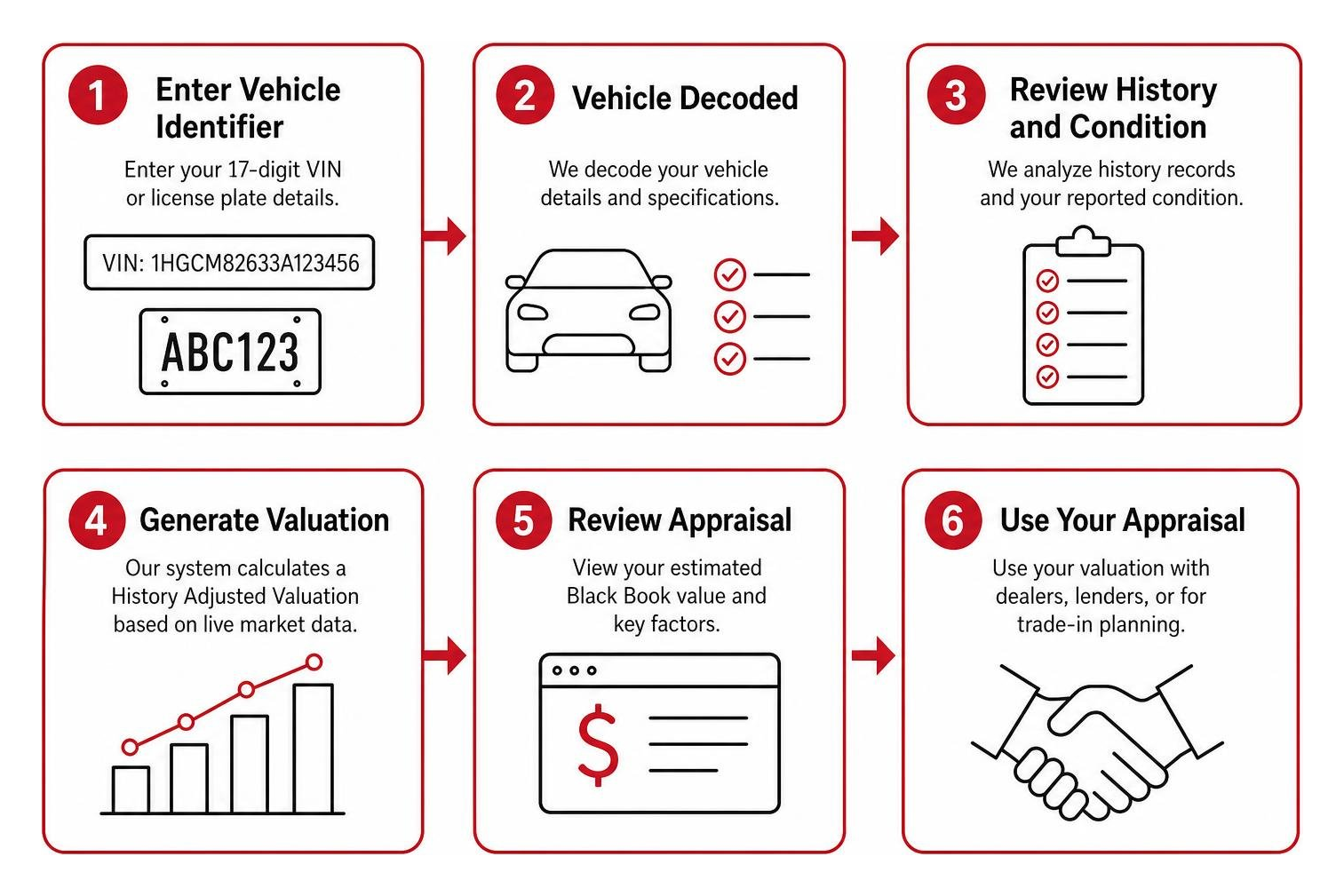
Using your exact 17-digit VIN ensures the valuation tool decodes the specific trim level, engine option, and factory-installed packages. Missing a premium package or choosing the wrong drivetrain can swing an estimate substantially. You should also gather detailed maintenance receipts, note current tire tread depth, and document any cosmetic imperfections so your inputs reflect real-world vehicle condition as closely as possible.
Auction Data vs Consumer Pricing Models
Why do wholesale auction numbers matter to you as a driver in Clayton County? When a dealership assesses trade equity, it evaluates what that specific make and model currently commands in the regional dealer market. Wholesale auctions reflect the actual capital dealers commit to acquire inventory under current supply-and-demand conditions.
Consumer-facing pricing tools provide a helpful starting point, allowing everyday drivers to understand broad retail market trends. When you combine consumer research with wholesale auction insights, you gain a balanced, realistic view of how your vehicle is valued across both wholesale acquisition channels and local retail markets. This comprehensive perspective helps you set grounded expectations before bringing your vehicle in for an in-person dealership appraisal.
Key Factors That Determine What Your Vehicle Is Worth
Every vehicle depreciates along a curve influenced by macro market shifts and individual ownership habits. New vehicles typically depreciate 15% to 20% in their first year and roughly 10% each subsequent year, though high-demand models often retain value more effectively over time.
Key elements that determine your appraisal include:
- Mileage Accumulation: Average driving is considered roughly 12,000 to 15,000 miles per year. Higher mileage incurs standard depreciation adjustments based on wear and component longevity.
- Mechanical Integrity: Powertrain performance, transmission health, suspension responsiveness, and brake condition.
- Exterior and Interior Wear: Scratches, dents, windshield chips, tire tread depth, upholstery condition, and cabin cleanliness.
- Documentation: Complete service records from certified service centers demonstrate responsible ownership and consistent maintenance.
Disclaimer: This vehicle valuation and maintenance guidance is for informational purposes only. Mechanical assessments and repair work should only be completed by a certified Nissan technician. Consult our service department and your vehicle owner's manual before conducting any maintenance or repairs.
Calculating the Black Book Value of My Car for Trade-In
When calculating your trade equity, the equation is straightforward:
Trade Equity = Appraised Trade-In Offer - Remaining Loan Balance
If your vehicle is appraised for more than your remaining loan balance, that positive equity can serve as a down payment toward your next vehicle. If you owe more than the appraisal value, that negative equity must either be settled out of pocket or rolled into your new financing package, subject to lender approval and vehicle loan-to-value limits. For practical tips on boosting your appraisal, explore our guide on maximizing your vehicle's trade-in value.
Market Demand, Mileage, and Regional Adjustments
Regional factors directly influence used vehicle values. In south Atlanta, dependable daily commuting performance and practical fuel efficiency drive strong pre-owned demand.
Efficient sedans like a used Nissan Sentra or used Nissan Altima remain popular choices for highway commuters traveling along I-75. Meanwhile, versatile crossovers like a used Nissan Rogue, used Nissan Murano, or compact used Nissan Kicks offer the flexible cargo room and fuel economy south Atlanta families look for.
Drivers requiring greater towing capability or seating capacity often look for a used Nissan Pathfinder, full-size used Nissan Armada with third-row seating, or a rugged used Nissan Frontier. Local demand for these body styles keeps regional trade-in values competitive across Clayton County.
Frequently Asked Questions About Vehicle Valuations
Is Black Book Value the Same as Dealership Trade-In Value?
No. An online Black Book estimate represents a generalized market benchmark based on regional wholesale averages. The actual trade-in offer from a dealership accounts for a physical vehicle inspection, necessary safety reconditioning, fresh tires, detailing, mechanical repairs, and current local lot inventory requirements.
How Often Does Black Book Update Vehicle Pricing Data?
Black Book updates its pricing continuously and publishes refreshed wholesale data at least weekly. This fast turnaround ensures values reflect recent dealer auction transactions, seasonal buying trends, and changing regional consumer demand.
What Details Do I Need to Check My Vehicle Valuation Online?
You will need your vehicle's 17-digit Vehicle Identification Number (VIN) or license plate number, current odometer mileage, and an honest assessment of physical and mechanical condition. Having your title status and recent maintenance records available also ensures an accurate estimate.
Can You Use Black Book Valuations to Negotiate Your Next Vehicle?
Yes. Knowing your vehicle's wholesale and trade-in baseline helps you establish realistic trade equity expectations before visiting the showroom. When you understand your equity position, you can structure a clear budget before exploring a new Nissan sedan, new Nissan SUV, or new Nissan truck.
Conclusion
Understanding vehicle valuation empowers you to make informed decisions for your daily driving needs and long-term budget. Whether you plan to transition into a dependable daily commuter, explore a quality model from our certified pre-owned inventory, or choose from our extensive lineup of used cars, used SUVs, and used trucks, knowing your trade equity provides clear direction.
When you are ready to explore your options or simply want to sell us your car, Nissan South Morrow can provide a fair, honest trade-in appraisal. You can quickly value your trade online, then visit our Morrow location to review your vehicle’s Black Book value alongside other book values used in the appraisal and move forward with clarity and confidence.